
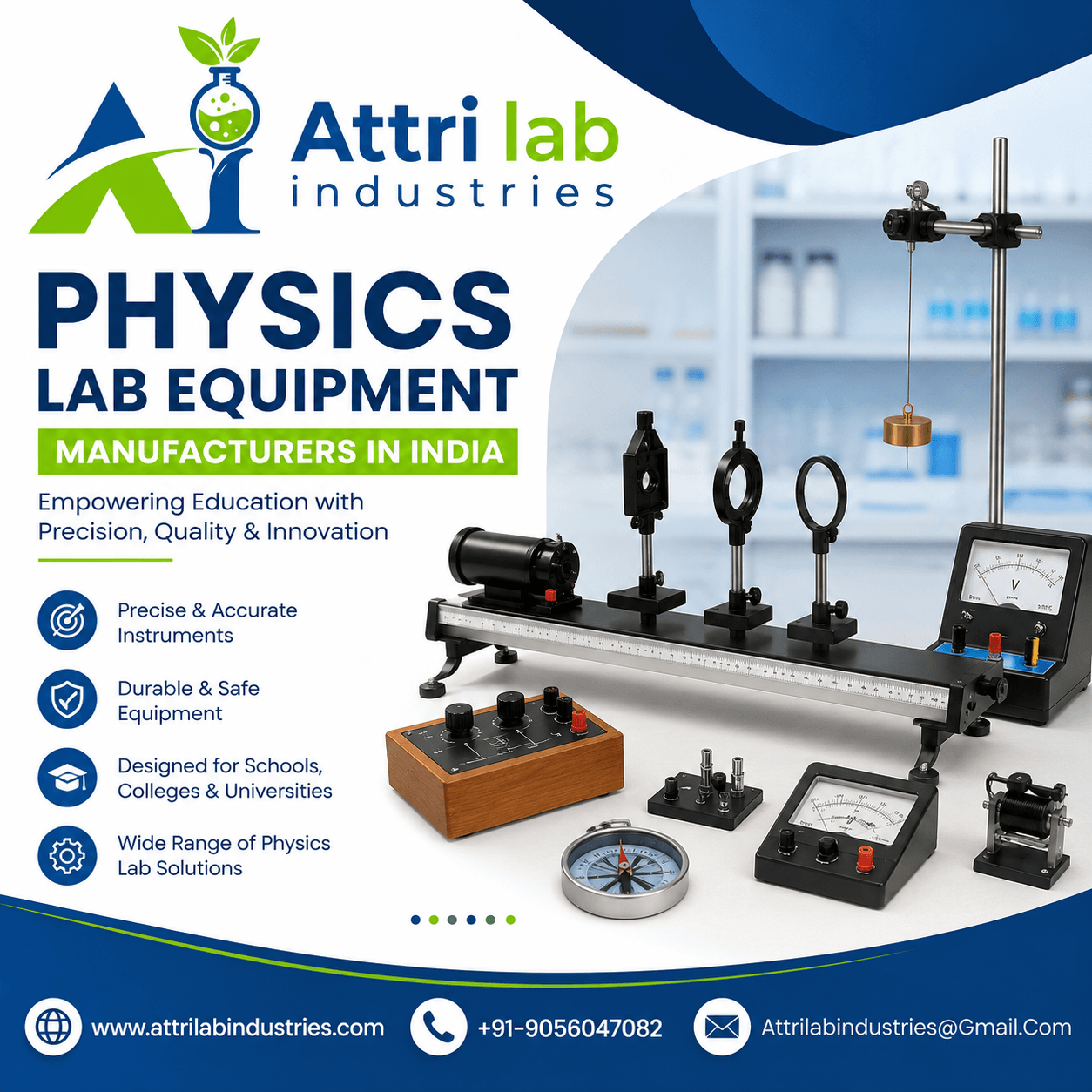
Physics is one of those subjects that becomes far more interesting when students get the opportunity to experience it beyond textbooks. Concepts such as motion, force, electricity, magnetism, optics, heat, and sound are easier to understand when students can perform experiments, take measurements, and observe the results themselves. This makes a properly equipped physics laboratory an important part of quality education.
For schools, colleges, universities, engineering institutions, and research organizations, choosing reliable Physics Lab Equipment Manufacturers in India is an important decision. The right laboratory equipment can make practical sessions more effective, improve accuracy, and give students the confidence to work with scientific instruments.
India has developed a strong market for laboratory and scientific equipment, with manufacturers supplying products for educational institutions and research facilities. Ambala, Haryana, in particular, is known for its scientific equipment manufacturing ecosystem.
Why Physics Laboratory Equipment Matters
A physics laboratory is not simply a collection of instruments. It is a practical learning environment where students learn how scientific principles work in real situations. Instead of memorizing formulas, they can perform experiments and understand the relationship between theory and observation.
For example, learning about the laws of motion becomes more meaningful when students actually measure force, acceleration, or movement. Similarly, concepts related to electricity become easier to understand when students build circuits and observe voltage and current readings.
Good-quality laboratory equipment helps provide consistent observations and makes experiments safer and easier to perform. This is why institutions should carefully evaluate the quality, construction, usability, and suitability of equipment before making a purchase.
Major Categories of Physics Lab Equipment
A complete physics laboratory may require equipment for several different areas of physics. The exact requirements depend on the institution's curriculum, student level, laboratory size, and practical syllabus.
Mechanics Equipment
Mechanics is one of the fundamental areas of physics. Students learn about force, motion, gravity, energy, momentum, and related principles through practical experiments.
Common equipment can include pendulum apparatus, lever apparatus, pulley systems, inclined plane setups, spring balances, weight sets, measuring instruments, and other mechanical experiment apparatus.
These instruments allow students to take observations and understand how physical laws operate in practical situations.
Optics Laboratory Equipment
Optics deals with the behavior and properties of light. Students commonly study reflection, refraction, lenses, mirrors, prisms, dispersion, and other optical phenomena.
Optical benches, lenses, mirrors, prisms, ray boxes, spectrometers, and related apparatus can make practical classes much more interactive. Instead of simply looking at diagrams in a textbook, students can observe the path and behavior of light themselves.
Electricity and Magnetism Equipment
Electricity and magnetism are essential parts of school, college, and engineering physics. Practical equipment helps students understand electrical circuits, resistance, current, voltage, magnetic fields, and electromagnetic effects.
Depending on the laboratory requirements, equipment may include ammeters, voltmeters, galvanometers, resistance boxes, power supplies, electrical circuit kits, coils, magnets, connecting wires, and other accessories.
Accurate measurement is particularly important in electrical experiments because even small inconsistencies can affect experimental observations.
Heat and Thermodynamics Equipment
Heat and thermodynamics experiments introduce students to temperature, thermal expansion, heat transfer, thermal conductivity, and energy-related concepts.
Laboratories may require thermometers, calorimeters, heat transfer apparatus, thermal conductivity equipment, and other experimental setups. Such instruments help students understand how heat behaves under different conditions.
Sound and Wave Equipment
Sound and waves can sometimes be difficult to understand through theory alone. Practical apparatus allows students to observe frequency, vibration, resonance, wavelength, and other wave-related phenomena.
Wave motion apparatus, resonance tubes, tuning forks, vibration equipment, and related instruments can be useful for demonstrating these concepts in an easy-to-understand manner.
What Makes Good Physics Lab Equipment
When institutions search for Physics Lab Equipment Manufacturers in India, they should look beyond the appearance or initial price of a product. Laboratory equipment is expected to handle repeated use, particularly in schools and colleges where many students may use the same apparatus throughout an academic year.
Some important qualities to consider include:
Accuracy: Instruments should provide dependable measurements for educational experiments.
Durability: Equipment should be constructed to withstand regular handling and repeated laboratory use.
Ease of Operation: Students and teachers should be able to understand and operate the apparatus without unnecessary complexity.
Safety: Equipment should be designed with appropriate safety considerations for practical classroom use.
Maintenance: Products that are easy to maintain can help institutions reduce long-term operational costs.
Curriculum Compatibility: Equipment should be suitable for the experiments included in the institution's syllabus.
Benefits of Choosing Indian Manufacturers
Buying from an Indian manufacturer can offer several practical benefits to educational institutions. Local manufacturers can often provide easier communication, product customization, competitive pricing, and accessible after-sales assistance.
Institutions setting up a new laboratory may also benefit from discussing their complete requirements directly with a manufacturer. Rather than selecting individual products without considering the overall laboratory, buyers can plan equipment according to available space, curriculum, student strength, and budget.
Customization can also be useful when an institution requires a specific experimental setup or a combination of apparatus for a particular practical course.
Attri Lab Industries for Laboratory Requirements
Attri Lab Industries is involved in the manufacturing and supply of laboratory equipment and scientific solutions for educational and institutional requirements. Its product range includes physics laboratory instruments along with other science and laboratory equipment.
For institutions, having access to a supplier that understands laboratory requirements can make procurement easier. The objective should be to select equipment that offers practical usability, dependable construction, and suitable performance for regular educational applications.
Importance of Practical Learning in Modern Education
Education is gradually becoming more practical and experience-based. Students are expected not only to understand concepts but also to develop observation, analytical, problem-solving, and experimental skills.
Physics practicals contribute significantly to this development. When students perform an experiment, record observations, calculate results, and compare their findings with theoretical expectations, they develop a deeper understanding of the subject.
Teachers also benefit from a well-equipped laboratory because practical demonstrations can make difficult topics easier to explain. A simple experiment can often communicate an idea more effectively than several pages of theoretical explanation.
Choosing the Right Manufacturer for Your Institution
Every laboratory has different requirements. A school laboratory may need basic and student-friendly apparatus, while a college or university may require more advanced instruments for higher-level practicals and research.
Before selecting a manufacturer, institutions should consider the complete product range, construction quality, technical specifications, customization options, delivery support, and after-sales service.
It is also useful to plan the laboratory as a complete system rather than purchasing equipment randomly. A well-planned setup ensures that students have access to the apparatus required for their practical curriculum without unnecessary duplication.
Building a Better Physics Learning Environment
A modern physics laboratory should encourage students to explore, experiment, and ask questions. Quality instruments are an important part of creating such an environment, but proper laboratory planning and teacher guidance are equally valuable.
With suitable equipment, students can move from simply reading about scientific principles to actually testing them. This practical experience can encourage curiosity and help students develop an interest in science, engineering, and research.
As educational institutions continue to emphasize hands-on learning, the demand for dependable Physics Lab Equipment Manufacturers in India is expected to remain important. Manufacturers that focus on quality, practical usability, and customer requirements can play an important role in supporting modern science education.
Conclusion
A well-equipped physics laboratory provides students with a practical foundation for understanding scientific concepts. From mechanics and optics to electricity, magnetism, heat, and waves, the right equipment can turn theoretical lessons into engaging experiments.
When selecting Physics Lab Equipment Manufacturers in India, institutions should focus on quality, accuracy, durability, usability, safety, and long-term support rather than choosing equipment based only on price.
With reliable laboratory equipment and proper practical guidance, schools, colleges, universities, and research institutions can create learning environments where students can experiment confidently and understand physics in a much more meaningful way. Attri Lab Industries can be considered as a source for institutions looking for laboratory and physics equipment suited to their practical learning requirements.